
11 Sep Cracked Tooth No Pain: What to Do Next
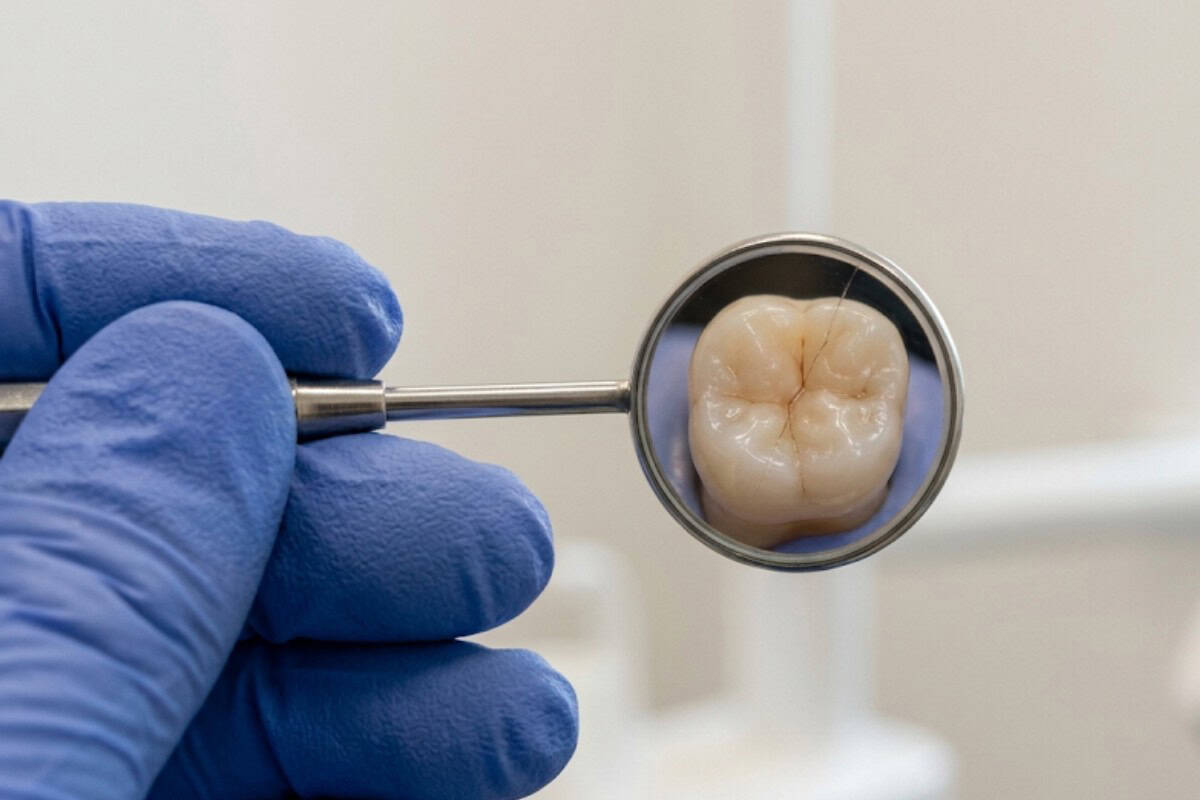
You bite down on a tortilla chip, hear a small click, and three days later notice a hairline crack running across an upper molar that does not hurt at all. Nothing throbs. Cold water feels normal. Chewing on that side is fine. So the question becomes easy to postpone, and most people postpone it.
If you have typed cracked tooth no pain what to do into your phone at 11 p.m., here is the short version: a painless crack is usually the best possible time to treat a tooth, not a reason to wait. The absence of pain tells you something specific about how deep the crack has traveled so far. It tells you very little about where that crack is headed.
Why a Cracked Tooth May Not Hurt at All
Teeth are layered, and only some of those layers can report trouble. The outer enamel shell has no nerve supply, so damage confined to enamel is typically silent. The Merck Manual notes that fractures reaching the intermediate layer, the dentin, are usually painful when exposed to air or food, which is exactly why enamel-only damage often produces no symptoms whatsoever. Pain shows up when the crack reaches nerve territory.
That layering explains the pattern clinicians see constantly. A crack you cannot feel may simply be a crack that has not yet reached the dentin or the pulp, the chamber holding the tooth’s nerve and blood supply. It is a stage, not a verdict.
There is a second reason for silence. Cracks that begin down in the root and travel upward often show minimal signs and symptoms, and they are frequently found only after infection or bone loss has already started. So “it doesn’t hurt” can mean the crack is shallow, or it can mean the crack is in a position where your nerve never gets the message. Only an exam can tell those two apart, which is why a suspected cracked tooth deserves a look even on a good day.
Cracked Tooth No Pain: What to Do in the First 24 Hours
The first day is about protecting the tooth and getting on the schedule, not about diagnosing yourself in the bathroom mirror. The American Dental Association advises rinsing the mouth immediately with warm water to clean the area, applying cold compresses to the face to keep swelling down, and seeing a dentist as soon as possible even when the damage seems minor.
- Rinse with warm water to clear debris from the cracked area.
- Put a cold compress or ice pack against the outside of your cheek if there is any swelling.
- Take an over-the-counter anti-inflammatory such as ibuprofen if the tooth becomes tender.
- Chew on the other side and skip ice, hard candy, and anything you have to bite through.
- Call a dentist and describe what happened, including what you were eating.
Nothing on that list fixes the crack. Tooth structure cannot knit itself back together, so the point of home care is to keep the tooth stable and comfortable until someone can actually examine it. Call our Tulsa office and ask for the first opening that works with your week.
The Five Types of Cracks, and What Each One Means
The American Association of Endodontists sorts cracked teeth into five types, and the category matters far more than the pain level. Craze lines are tiny cracks affecting only the outer enamel; they need no treatment and are essentially cosmetic. A fractured cusp happens on the chewing surface, often around an existing filling, and is usually repaired with a new filling or a crown, with a good outlook because the crack has not reached the pulp.
A true cracked tooth is one where the crack extends from the chewing surface vertically toward the root. That one typically needs a root canal procedure and a crown, and the tooth can usually be saved if it is caught before the crack keeps running. A split tooth is described as the result of long-term progression of a cracked tooth: the tooth has separated into segments and cannot be saved intact, though endodontic treatment may save a portion of it. A vertical root fracture begins in the root and extends toward the chewing surface, often shows minimal signs and symptoms, and frequently ends in extraction or endodontic surgery.
| Type of crack | What it looks or feels like | Typical treatment | Can the tooth be saved? |
|---|---|---|---|
| Craze lines | Tiny cracks affecting only the outer enamel; no symptoms | No treatment needed; cosmetic only | Yes, the tooth is not at risk |
| Fractured cusp | Break on the chewing surface, often around an existing filling | New filling or a crown | Yes, good outlook; the pulp is usually not involved |
| Cracked tooth | Crack extends from the chewing surface vertically toward the root | Root canal procedure plus a crown | Usually, if treated before the crack spreads |
| Split tooth | Long-term progression of a cracked tooth; separated into segments | Endodontic treatment may save a portion | Not intact; part of the tooth may be saved |
| Vertical root fracture | Begins in the root, extends toward the chewing surface; minimal signs and symptoms | Extraction, or endodontic surgery in some cases | Often not; extraction is common |
Notice what that progression implies. The difference between a fractured cusp and a split tooth is often nothing more than time and chewing pressure.
Why Cracks Do Not Heal
Bone repairs itself. Tooth structure does not. Once enamel and dentin fracture, there is no biological process that closes the gap, and every bite you take applies force across that line. The Cleveland Clinic states plainly that cracked teeth do not always cause symptoms, and it also notes that people age 50 and older are more likely to have tooth cracks than younger people.
An untreated crack that eventually becomes infected can bring bad breath, persistent pain, fever, and swollen glands. Those are the late chapters of a story that started quietly. Waiting does not preserve options; it removes them one at a time.
What Treatment Usually Looks Like
Diagnosis comes first, because you cannot see most of a crack from the outside. Dentists use magnified visual inspection, a dental explorer that catches on rough cracked edges, dental dye, and X-rays to judge whether the pulp is healthy. That is why a self-check in the mirror is not a substitute for an exam.
Treatment then scales with how deep the crack runs. A tiny crack causing no discomfort may need no treatment at all beyond monitoring. Moderate damage is handled with bonding, contouring, a filling, or a crown. Deep cracks that reach the pulp call for root canal treatment, and teeth that cannot be saved are extracted and replaced. Nationally, Healthline puts a crown around $1,000 to $1,500, a root canal around $500 to $2,000, and an extraction around $150 to $250. Your own cost depends on the tooth and your coverage, so call and we will walk through your specific situation.
When a Painless Crack Becomes an Emergency
Some signals mean stop waiting and call today rather than next month. A brief, sharp pain while chewing or while eating something cold can indicate an incomplete fracture reaching into deeper tooth structure. A red spot or a bit of blood at the fracture site suggests the pulp is exposed, which pushes the situation toward root canal treatment.
Fever, swollen gums or glands, bad breath, or worsening pain point to infection, and infection is a genuine emergency rather than a scheduling question. Delaying treatment once those signs appear puts the rest of your mouth at greater risk, and follow-up visits matter after fracture treatment because complications can develop later.
Why Choose Magnolia Family Dental Care
A crack that does not hurt is the best window you will get, because the pulp is not yet involved and the simplest repairs are still on the table. Our cracked tooth page walks through the same categories described above, craze lines, fractured cusp, split tooth, and vertical root fracture, so you can compare what you are seeing before you ever sit in the chair. Dr. Melissa Jackson, DDS, and the team at our South Tulsa office can usually accommodate same-day and walk-in emergency appointments, which matters when a crack turns loud overnight.
Everything a cracked tooth might need is handled here in Tulsa, Oklahoma: bonding for shallow damage, crowns for fractured cusps, and root canal treatment when a crack has reached the pulp. Digital X-rays are taken on site, sedation dentistry is available for anxious patients, and Spanish is spoken in the office. Patients drive in from Broken Arrow, Bixby, Jenks, Owasso, Sand Springs, and Catoosa, and we file and track insurance claims electronically, with CareCredit financing available subject to approval.
Conclusion
A painless crack is a timing advantage, not a free pass. Enamel has no nerves, so a crack can travel quietly for months before it announces itself, and by then the fix is usually bigger than bonding. The five crack categories make the stakes clear: craze lines need nothing, a fractured cusp needs a filling or crown, a true cracked tooth typically needs a root canal and a crown, and a split tooth or vertical root fracture may cost you the tooth entirely. If you have spotted a line in a molar and felt nothing, that is the moment to act. Call Magnolia Family Dental Care in Tulsa, Oklahoma and let us take a proper look.
Get That Crack Looked At Before It Spreads. Call or book an appointment online, and tell us what you were eating when you felt the crack. We can usually fit in same-day emergency and walk-in appointments.
Frequently Asked Questions About a Cracked Tooth With No Pain
Can a cracked tooth heal on its own?
No. Unlike bone, tooth structure has no way to repair a fracture once it forms. Chewing pressure tends to drive the crack deeper over time, which is why a cracked tooth is described as progressing into a split tooth when it is left alone for long enough.
How long can a cracked tooth go untreated?
There is no safe waiting period, because a crack can deepen at any point without warning. Shallow enamel cracks may sit quietly for years, while a crack heading toward the pulp can reach it in weeks. Since you cannot tell which one you have without an exam, prompt evaluation is the only reliable answer.
Can I ignore a cracked tooth if it doesn’t hurt?
Painless does not mean harmless. Cracked teeth do not always cause symptoms, and vertical root fractures in particular often show minimal signs until infection or bone loss has developed. A dentist should confirm the type and depth of the crack before anyone decides it can be watched.
Why does my cracked tooth still need a crown if it doesn’t hurt?
A crown holds a weakened tooth together so chewing forces do not widen the crack. Fractured cusps and true cracked teeth lose structural strength even when the nerve is still comfortable, so restoring that strength is preventive rather than reactive.
How do you know if a cracked tooth needs a root canal?
Root canal treatment becomes likely when the crack reaches the pulp, the nerve chamber inside the tooth. Signs include sharp pain on biting or with cold, and a red spot or bleeding at the fracture line. X-rays and testing of pulp health confirm whether the nerve is involved.
Sorry, the comment form is closed at this time.